Once the world’s leading crypto derivatives exchange, BitMEX has weathered the storms of regulation, market crashes, and shifting user expectations. Today, under CEO Stefan Lutz, it stands as a profitable, founder-owned company focused on sustainability and integrity in a volatile industry.
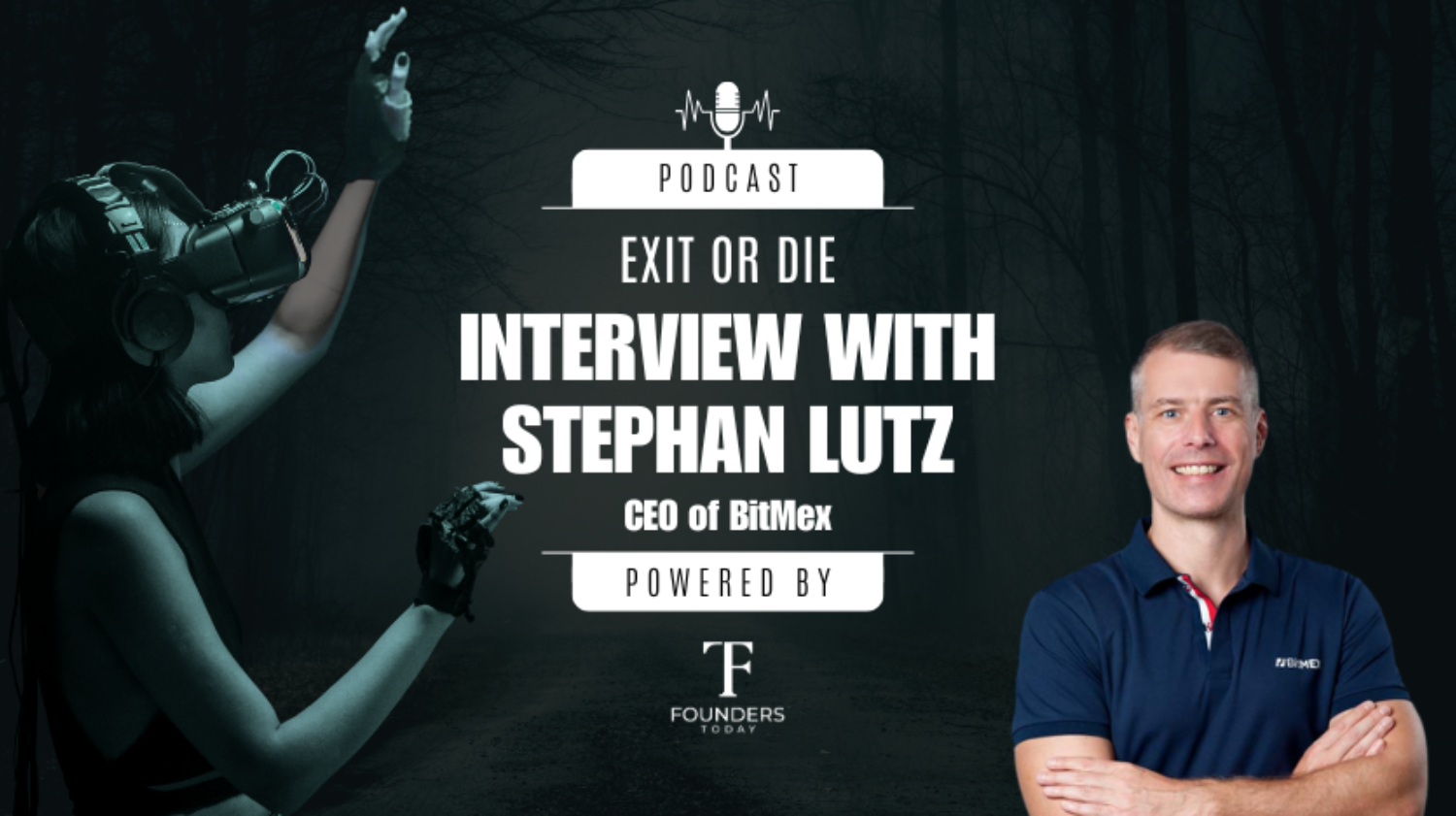
In a recent episode of the Exit or Die podcast, Stefan Lutz, CEO of BitMEX, opened up about the company’s evolution — from its early dominance to its reinvention as a lean, focused, and cashflow-positive platform.
BitMEX, founded in 2013, was more than just another crypto exchange — it was a revolutionary trading venue that helped define what modern crypto derivatives trading looks like today. But as the industry matured and regulations tightened, the company was forced to reinvent itself.
Lutz describes BitMEX today as “the quiet animal in the space” — a company that no longer chases the spotlight, but quietly continues to thrive on its core strengths: innovation, security, and trust.
The Birth of BitMEX: Solving a Problem, Not Chasing a Trend
The story of BitMEX begins in the aftermath of Mt. Gox, the infamous 2014 exchange collapse that shook early crypto markets. Traders needed a secure, transparent, and technically sound place to trade — and that’s what BitMEX’s founders set out to build.
“The founders solved their own problem,” says Lutz. “They wanted a platform where they could trade crypto without worrying if their coins would still be there the next day.”
From that problem statement came a series of industry-defining innovations:
- The Perpetual Swap – a derivative instrument that lets traders speculate on Bitcoin’s price without expiry, later adopted by nearly every major exchange.
- A Transparent Wallet and Audit System – ensuring that no coin could leave the platform unnoticed, setting new standards for custody and security.
- The Funding Rate Mechanism – a dynamic balancing tool that keeps perpetual contracts aligned with spot prices.
- The Insurance Fund Model – designed to prevent cascading liquidations and protect traders from counterparty risk.
Together, these innovations allowed BitMEX to scale rapidly, turning it into the undisputed leader in crypto derivatives.
“BitMEX became a monopoly — not because of marketing or hype, but because there was simply no alternative,” says Lutz.

The Fall — and the Fight Back
But even giants stumble. Around 2019–2020, BitMEX faced a perfect storm of challenges: regulatory pressure, scaling issues, and a fast-changing competitive landscape.
As the U.S. government increased its scrutiny of unregulated crypto platforms, BitMEX — whose founders were U.S. citizens — became a high-profile target. “We were number one, and that made us a target,” Lutz says bluntly.
The legal scrutiny triggered uncertainty among traders, while new exchanges like Binance, Bybit, and FTX emerged with aggressive marketing tactics and a new playbook: retail-driven growth, influencer partnerships, and viral hype campaigns.
At the same time, BitMEX took a controversial but forward-thinking decision: it became one of the first major exchanges to implement full KYC.
“When we introduced full KYC in 2019, there was no regulatory requirement for it yet,” Lutz explains. “But we did it because we wanted a legitimate, sustainable business. We wanted to set the gold standard.”
That shift wasn’t without cost. Many users, attracted to crypto’s anonymity, left the platform. Yet in hindsight, it was the right move — paving the way for BitMEX to operate cleanly and compliantly in an increasingly regulated world.
“It wasn’t really a restructuring,” Lutz says. “It was a return to our core. We built BitMEX for professional, consistent, rule-based traders. That’s who we are again today.”
Competing on Substance, Not Noise
While competitors raced for market share through flashy marketing and token incentives, BitMEX took a different approach: it doubled down on product quality, risk management, and technology.
The exchange overhauled its platform twice, addressing scalability and latency issues that arose during its early hypergrowth phase. Today, it’s built for high-volume traders who demand institutional-grade performance and reliability.
“Security isn’t a product — it’s a practice,” says Lutz. “You can’t buy trust. You have to earn it every day.”
And BitMEX has lived up to that motto. Despite countless attacks over the years, the company has never lost a single coin. That record of reliability is now a key differentiator in an industry marred by exchange collapses and hacks.
Staying Private — and Profitable
In a sector filled with venture-backed players chasing the next funding round, BitMEX stands out as 92% founder-owned and entirely self-funded.
The company generates more than $80 million in annual revenue and operates cashflow positive — a rarity among crypto exchanges that often rely on speculative funding.
Lutz is clear about the company’s philosophy: “We’re not playing the VC game. In venture capital, it’s a numbers game — one winner for every thousand failures. That’s not how we operate. We’re building a real business, not a lottery ticket.”
That independence gives BitMEX the freedom to focus on long-term stability rather than short-term growth. It also aligns with Lutz’s vision of building a company that lasts beyond market cycles — a crypto equivalent of traditional financial institutions that have stood the test of time.
“If we were a bank,” Lutz jokes, “we’d be the Rothschilds of crypto — once the biggest, now a specialized player with deep expertise.”
BitMEX 2.0: The Professional’s Platform
Today, BitMEX serves a refined audience: professional traders, institutions, and sophisticated individuals who value transparency, security, and performance over marketing hype.
Its fully verified trading environment and strong compliance framework have positioned it as a trustworthy, high-integrity exchange in a market still struggling with reputation issues after the collapses of FTX and others.
“On October 10th and 11th, during a high-volatility event, we had the fewest liquidations and the lowest amount of auto-deleveraging in the industry,” says Lutz. “That’s proof our systems work the way they’re supposed to.”
In a world of leverage, speculation, and constant innovation, BitMEX’s steady, measured approach stands out.
Back to the Core: Building for the Long Game
BitMEX’s journey mirrors the evolution of the entire crypto industry — from wild experimentation to maturity and accountability.
After a decade of highs, lows, and reinvention, the company’s strategy is simple: focus on what works, stay independent, and uphold the principles that made it successful in the first place.
“We’re not the loudest,” Lutz says, “but we’re still here. We survived, we adapted, and we’re profitable. That’s the real story.”